
| Mysore Cucamelon |

|
 |

|


| File size | 469178 |
| Original date | 12/28/24 11:48 AM |
| Resolution | 2048 x 1536 |
| Flash | Flash did not fire, auto |
| Focal length | 6.06mm |
| Exposure time | 1/343s |
| Aperture | 1.69 |
| Focus Distance | |
| Metering Mode | Center weighted average |
| Camera make | realme |
| Camera model | realme 11 Pro+ 5G |
| Sensor type | Undefined |
 |
 ative ative |
 |
 |
 |
Photo: |
Botanical name: Zehneria maysorensis Family: Cucurbitaceae (Pumpkin family)
Synonyms: Melothria maysorensis, Bryonia maysorensis, Zehneria lucida
Synonyms: Melothria maysorensis, Bryonia maysorensis, Zehneria lucida
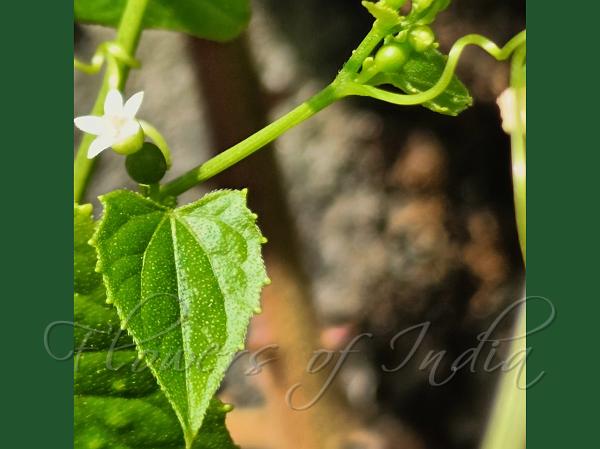
Mysore cucamelon is a herbaceous climbers with stem
slender, hairless. Leaves are alternate, 7-8 x 6.5-8 cm, broadly ovate,
heart-shaped at base, pointed-tapering at tip, shallowly 3-angled,
sawtoothed along margins, minutely and densely punctuate above,
hairless to minutely papillate beneath; nerves usually sparsely bristly
beneath; leaf-stalk 2-3 cm long; tendrils simple. Flowers are
cream-yellow. Male flowers are borne in umbels, carried on
flower-cluster-stalks 2-4 cm long. Flower-stalks about 2 mm long.
Petals are ovate, pointed at tip, about 2.5 mm long. Stamens 3;
filaments about 3 mm long; anthers about 1 by 1.25 mm, papillose.
Sepal-cup is bell-shaped, about 3 mm long, hairless outside, hairy
inside; sepals minute, teeth-like. Female flowers are borne singly in
leaf-axils, on flower-stalks about 2 mm long. Sepal-cup is oblong,
about 6 x 2 mm. Style is about 3.5 mm long; stigma spreading.
Staminodes are 3, thread-like, about 3 mm long, hairy. Fruits are
oblong, about 1.7 x 1.1 cm, finely netveined rugose. Mysore cucamelon
is found in Western Ghats, East Himalaya to Indo-China. Flowering:
October-December.
Medicinal uses: Leaves are edible. Leaves are
mixed with honey to kill stomach worms. Fruits are used as a blood
purifier.
Leaves are edible. Leaves are
mixed with honey to kill stomach worms. Fruits are used as a blood
purifier.
Medicinal uses:
Leaves are edible. Leaves are
mixed with honey to kill stomach worms. Fruits are used as a blood
purifier. | Identification credit: S. Kasim | Photographed in Vagamon, Kerala. |
• Is this flower misidentified? If yes,